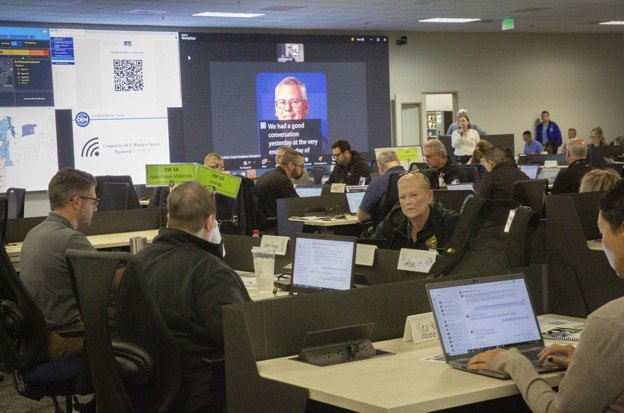
The Oregon Department of Emergency Management began a four-day exercise Tuesday, Oct. 13, simulating how the state would recover from a major volcanic eruption.
The drill, called "Getting Through Lahar'd Times," runs through Friday, Oct. 16, and brings together state agencies, counties, Tribes and community partners. It is the first statewide exercise to focus on long-term disaster recovery rather than the immediate emergency response that dominates most such drills, according to OEM.
The exercise is close to home. OEM is headquartered in Salem and coordinates the state's disaster planning from the capital city.
The drill tests the Oregon Disaster Recovery Base Plan, adopted earlier this year. The plan is part of the state's Comprehensive Emergency Management Plan and was shaped by lessons from the 2020 Labor Day wildfires, according to a July OEM announcement. It covers seven recovery areas, including housing, economic recovery, health services and infrastructure.
"The value of these exercises is that they let us practice the hardest days of a disaster without the consequences of an actual event," Robert Quinn, OEM exercise officer, said in an Oct. 11 statement. "We learn what works, what needs strengthening, and how we can better support communities when the real thing happens."
Participants will work through damage assessments, develop a State Recovery Action Plan and coordinate resource allocation. The scenario builds on two prior biennial exercises: Cascadia Rising in 2016, which simulated the first 72 hours after a Cascadia Subduction Zone earthquake, and IronOR24 in 2024, which extended that scenario into days four through seven.
The exercise also marks a first for community involvement. Volunteers, representatives from disaster-response organizations and people connected with under-resourced communities are serving as observers and evaluators. OEM Director Erin McMahon said in an Oct. 11 statement that their feedback will help the state improve recovery strategies and "make them stronger and more equitable."
McMahon credited staff members Natasha Fox, Robert Quinn and Quinn Butler, the agency's disaster recovery program manager, for building the community partnership that made the inclusion possible.
OEM's exercise page lists a schedule and resource library for those following along.