
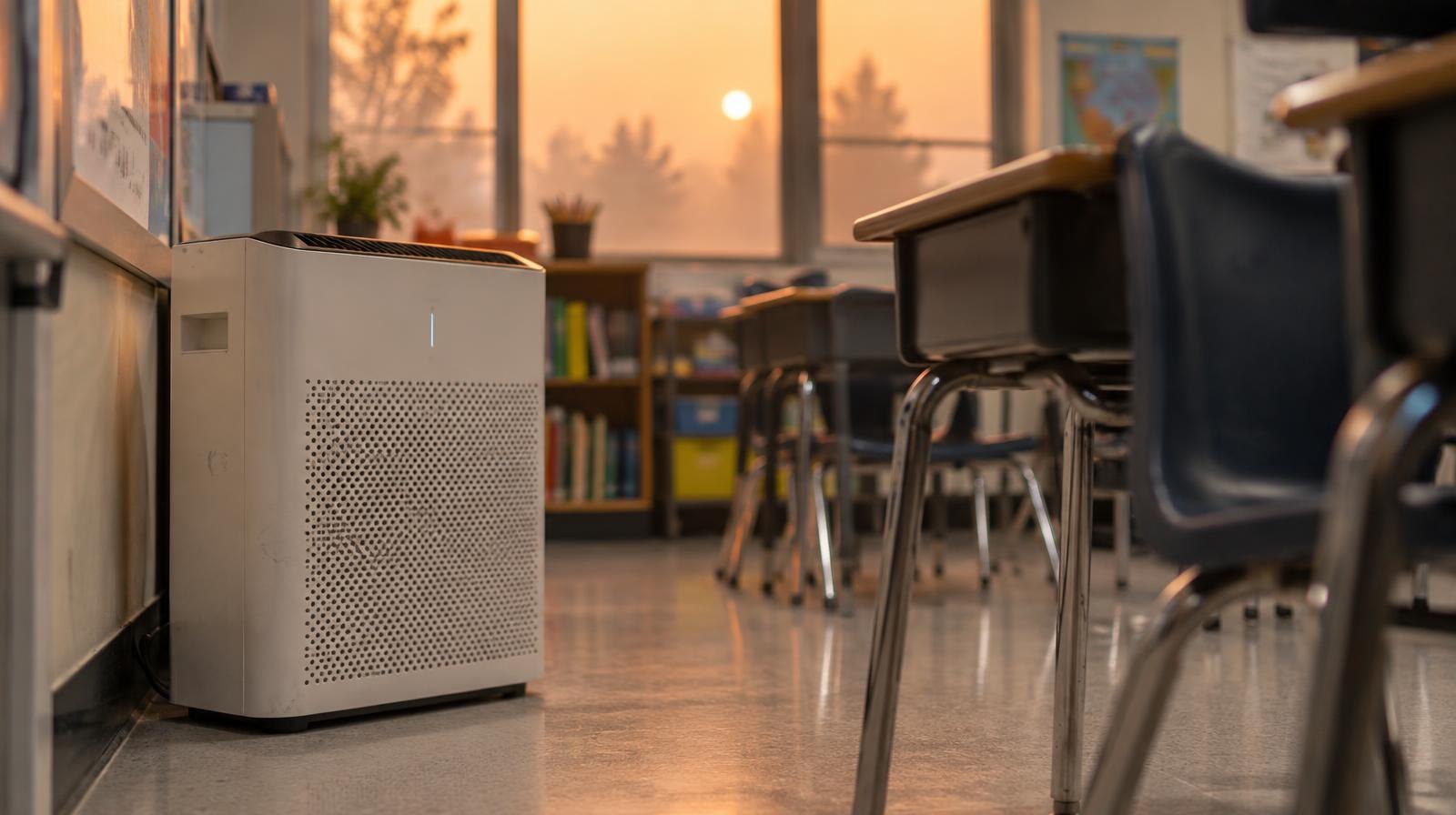
Wildfire smoke days at U.S. public schools have increased eightfold in less than two decades, according to a new study co-authored by Oregon State University researchers.
The study, published in the journal Environmental Research, analyzed air quality data from 2006 through 2023 across the country. Annual smoke days at public schools rose from 6.8 to 54.4 over that period, the Polk County Itemizer-Observer reported. Childcare centers saw an even steeper climb, going from 9.4 to 112.2 smoke days per year.
"Our children are collectively experiencing billions of days of smoky air each year," said Molly Kile, an environmental epidemiologist in the OSU College of Health and a co-author of the study.
The increase accelerated sharply between 2019 and 2023 across all U.S. regions, according to the study. The western U.S. saw more severe smoke days, but the South and Midwest recorded higher average totals when prescribed and agricultural burns were included.
Staying indoors isn't enough
One finding stands out for school districts weighing how to protect students: some buildings made air quality worse, not better.
At least 11 public schools in the West consistently had poorer indoor air quality than nearby outdoor air on smoke-impacted days between 2018 and 2023, the study found. Kile said indoor air quality measurements showed substantial variation in how well buildings shielded occupants from fine particulate pollution, known as PM2.5.
PM2.5 particles are small enough to reach deep into the lungs and enter the bloodstream. The researchers noted these particles are known health hazards, especially for adolescents and younger children.
"Some schools had higher indoor PM2.5 concentrations than nearby outdoor measurements during smoke days," Kile said. She called the finding "particularly actionable" and said it "emphasizes the need for investment in improving indoor air quality in schools through HVAC upgrades, which can be expensive, or portable HEPA filters, which can be a more affordable approach."
The study cited research showing portable HEPA filters can cut indoor particle levels to 10–50% of outdoor concentrations.
What it means for Salem-Keizer
Salem-Keizer Public Schools, the state's second-largest district with 65 schools and a $1.1 billion budget, lists wildfire smoke exposure among the responsibilities of its Environmental Health and Safety Specialist position. That role includes making recommendations on indoor air quality and coordinating compliance with the Oregon Department of Education's Healthy and Safe Schools Plan.
Whether the district has deployed HEPA filters, upgraded HVAC systems for smoke events, or adopted a formal smoke-day action plan for students is not detailed in its publicly available materials.
Low-income schools hit hardest
The study found rural schools with higher proportions of low-income students experienced more smoke days over the 17-year period than urban and higher-income schools. As of 2020, roughly 36,000 U.S. schools needed HVAC system upgrades, according to the U.S. Government Accountability Office data cited in the study.
Nearly half of all public school districts rely on local property taxes to fund facilities, leaving high-poverty areas dependent on state aid. The study's authors said these funding gaps disproportionately affect districts serving students of color, students from low-income backgrounds and English learners.
Stephanie Foster, the study's corresponding author and scholarly activity program manager in Samaritan Health Services' Research Development Office, said schools can take concrete steps. She pointed to coordinated preparedness plans, air filtration, indoor air quality monitoring and changes to outdoor activities during smoke events as ways to reduce exposure.
Childcare centers face particular urgency. They operate year-round during periods of heightened wildfire activity and serve the youngest, most vulnerable children. The National Institute of Environmental Health Sciences funded the research.