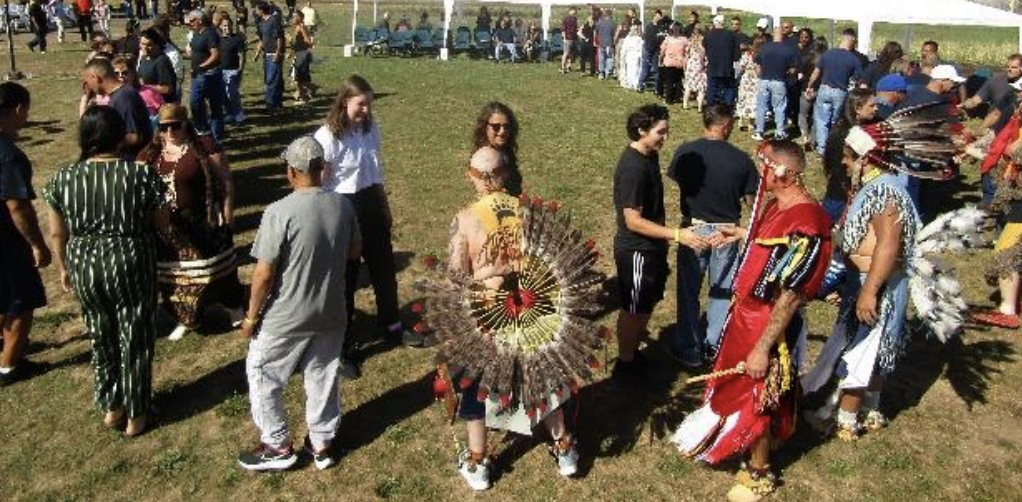
For more than 30 years, incarcerated Native American men at the Oregon State Correctional Institution have gathered each summer to dance, drum, and reconnect with their heritage.
On Tuesday, July 28, roughly 80 outside guests walked through the gates of the medium-security prison on Salem's north side to join them.
The Many Nations Powwow, organized by OSCI's Many Nations Culture Club, drew family members, law students, and honored guests including Shoshone-Bannock storyteller Ed Edmo and Lewis & Clark Law School professor Aliza Kaplan, according to Brian Bull's reporting for Underscore Native News.
Anthony Salazar, 48, Apache, stood by a rawhide drum as his wife Stephanie helped adjust the straps and laces of his regalia. The white, black, red, and yellow colors represent the four directions.
After 24 years inside OSCI, this was the first powwow where Salazar dressed in regalia and danced. It was Stephanie's first powwow anywhere.
"I'm in here for two counts of murder, and I got a life sentence. I've been in 24 years," Salazar said. "I'm very fortunate to be here, it means a lot. This is actually the first powwow where I've actually dressed up in regalia. And I'm going to dance."
Charlie Tladatsi, of Mescalero, Tsalagi, and white descent, has been at OSCI since the powwow's earliest days. He said reconnecting with culture shifts how people think and behave, and that healing inside means healing carries home.
The event featured intertribal dances, a feast with frybread and deer and elk meat, and a powwow version of musical chairs where incarcerated men held hands and laughed with loved ones. As the grand entry kicked off, a lone red-tailed hawk circled overhead.
Nestor Diaz-Miller, 37, of Cow Creek Band of Umpqua heritage, gestured toward the prison's sweat lodge and the drummers nearby. He said the sweat lodge and drum saved his life after years of suicidal thoughts.
Now younger inmates look to him for guidance on how to sing, drum, and practice ancestral ways.
Shawn Jeffers-Monro, a primary MNCC organizer who has been adopted by the Klamath Modoc people, said participants practice all year for the event. Three years ago, when his mother was dying of cancer, the powwow allowed him to hold ceremony with her and say goodbye.
Kaplan, who directs Lewis & Clark's Criminal Justice Reform Clinic and has attended the powwow about five times with her students, called it the event that "feels maybe the most free" of all the prison events she attends across Oregon.
MMIW scholarship launched from inside OSCI
At the July 19, 2025 powwow, the MNCC unveiled a scholarship honoring Missing and Murdered Indigenous Women. The club seeded it with $1,000, half of a $2,000 grant from the Siletz Charitable Contribution Fund, plus personal contributions from inmates' relatives and friends, according to an Oregon Department of Corrections document.
The scholarship is open to students pursuing a law degree and to students enrolled in a federally recognized tribe who are obtaining counseling credentials in substance abuse, mental health, behavioral health, or social services. The club plans to continue funding it through donations and MNCC-approved fundraisers.
How to attend
Outside guests must be invited by an incarcerated person, pass a background check, and comply with restrictions on objects and clothing. Phones are surrendered at the main gate. Guests who pass screening can be invited back each year. The powwow is held annually each summer at OSCI on Salem's north side. No date has been announced for the 2027 event.