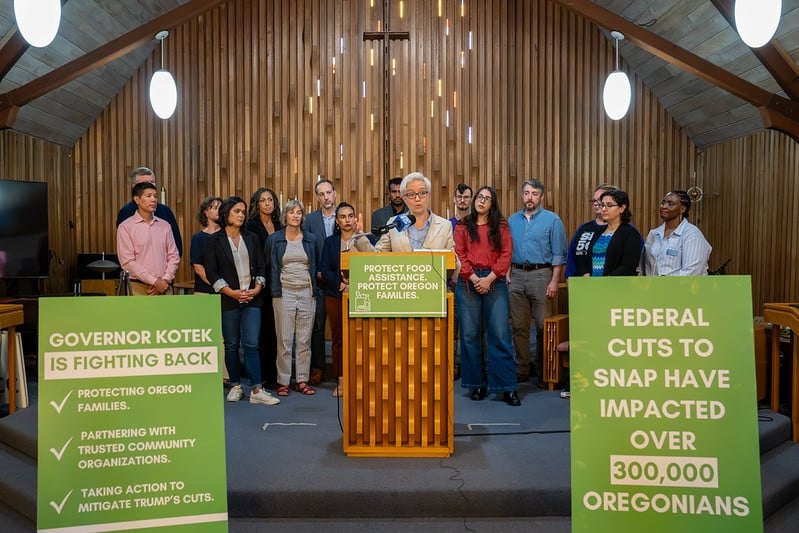
About 111,000 fewer Oregonians are receiving food stamp benefits than before federal cuts took effect, straining food banks across the Salem area and statewide. Gov. Tina Kotek met with six families who lost their SNAP assistance to hear what that means on the ground.
Kotek convened a recorded roundtable on Sunday, Aug. 16, at Ecumenical Ministries of Oregon's food bank in Northeast Portland, the state's largest food bank, which had served roughly 350 people earlier that day.
The governor's office said approximately 35,000 Oregonians have lost SNAP benefits specifically because of expanded work requirements under HR 1, the federal legislation signed by President Trump. Oregon's total SNAP enrollment dropped from about 757,000 to 646,000 by June, according to the governor's office.
Under the new rules, SNAP recipients aged 64 or younger who do not share food with a child under 14 must document at least 80 hours per month of work, volunteering or job training to keep benefits. HR 1 expanded those requirements to all Oregon counties and raised the age limit from 54 to 64.
"What they are doing with the program complexity and the red tape is pulling the rug out from under them and saying, 'Sorry, we really don't want to help you,'" Kotek said at the roundtable, as reported by The Oregonian. She partially attributed 38,000 Oregonians losing benefits to the added documentation burden.
Kotek's reelection campaign also released a television ad focused on the SNAP cuts on Aug. 16, The Oregonian reported. She faces Republican state Sen. Christine Drazan.
Statewide, visits to food assistance sites have jumped 51% over the past two years, according to Oregon Food Bank Executive Director Andrea Williams, who attended the roundtable. Her organization distributed 125 million pounds of food through 21 food banks across Oregon last year.
Other participants included Rep. Andrea Valderrama, who chairs the House Ways & Means Subcommittee on Human Services; state Sen. Lisa Reynolds; Jihane Nami, associate director of programs at the Immigrant and Refugee Community Organization; John Burt, executive director of Farmers Ending Hunger; and ODHS eligibility workers. Mark Edwards, director of Oregon State University's Policy Analysis Lab, warned that the federal government has ended funding for key food insecurity data collection, making it harder to track where hunger is worst.
Valderrama said the state is partnering with Kotek to roll out new SNAP EBT cards with chips to prevent benefit theft in coming months. The Oregon Department of Human Services is also connecting people subject to work requirements with employment and training opportunities through WorkSource Oregon.
Residents who need help with SNAP can call ODHS at 1-800-699-9075, visit a local office or dial 2-1-1.