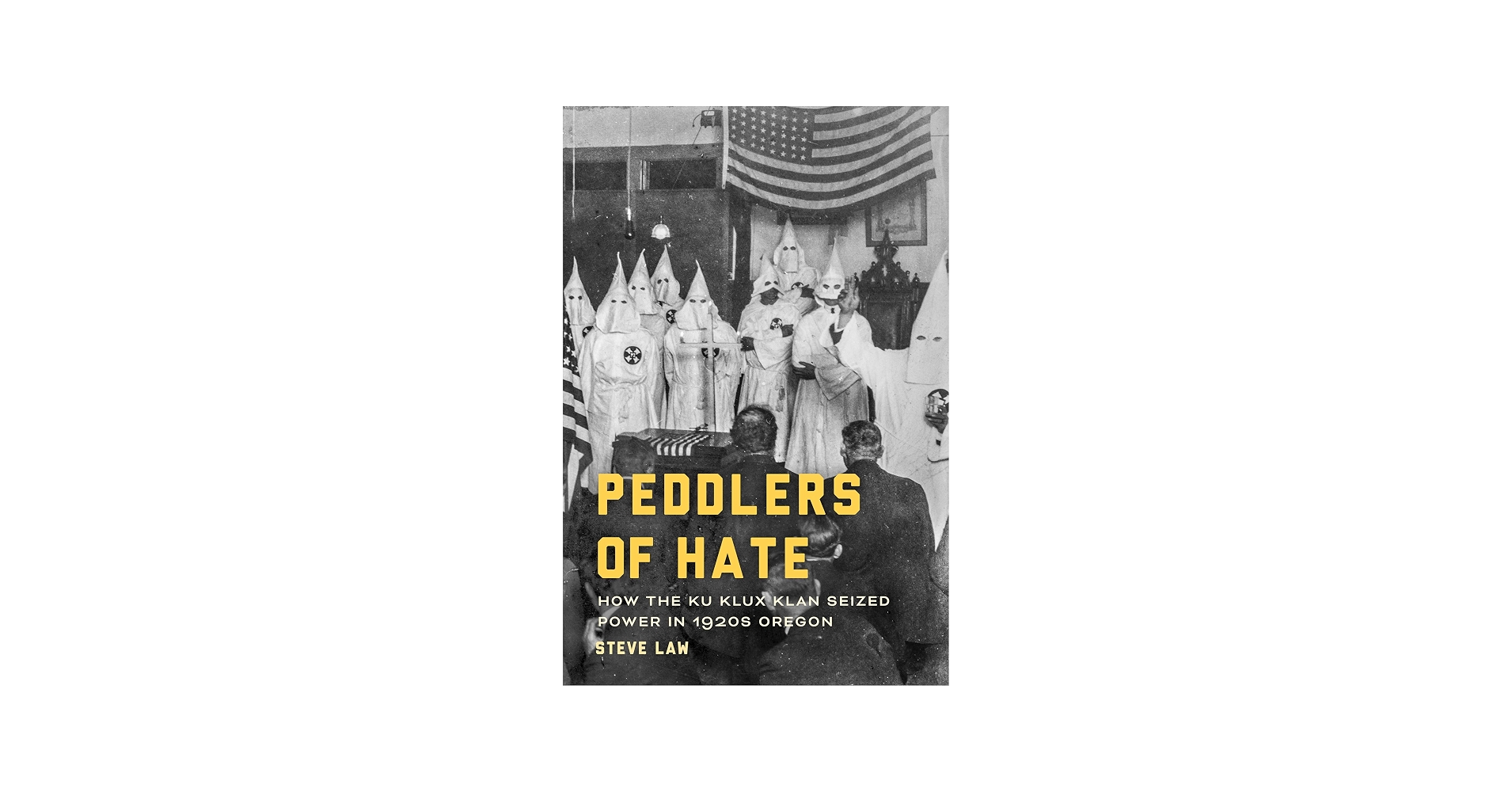
When the Ku Klux Klan swept through Oregon in the early 1920s, burning crosses at Salem's state fairgrounds and claiming roughly 50,000 members statewide, one Salem newsroom refused to look away.
A new book by veteran Oregon journalist Steve Law documents how Capital Journal editor George Putnam and reporter Harry Crain became among the fiercest press opponents of the Klan in a state where most newspapers stayed silent.
"Peddlers of Hate: How the Ku Klux Klan Seized Power in 1920s Oregon," published in August by Oregon State University Press, runs 292 pages and costs $29.95 in paperback.
Law, a former Salem Statesman Journal and Portland Tribune reporter who has won more than 50 journalism awards including Oregon's Bruce Baer Award twice, expanded the book from a five-part series he published in the Portland Tribune in 2022.
He will read from the book at 7 p.m. Wednesday, Aug. 26, at Powell's Books, 1005 W. Burnside St., Portland.
Salem's role
Oregon's Klan membership rate, about 4.2% of the population, trailed only Indiana's, according to Oregon ArtsWatch. More than 60 chapters operated across the state, and Portland hosted the nation's sixth-largest chapter. The Klan helped elect Democrat Walter M. Pierce as governor in 1922 and pushed through a ballot initiative banning private and Catholic schools, a law the U.S. Supreme Court struck down unanimously in 1925.
Fewer than a dozen Oregon newspapers challenged the Klan openly. Putnam, a New England native who purchased the Capital Journal in 1919, was among the loudest. The Oregon Encyclopedia calls him the state's strongest newspaper opponent of the Klan, noting he ridiculed what he called their "senseless and silly public appearances in nightgown regalia" and chided Portland editors for timidity.
Putnam weathered physical threats and an advertising boycott organized by local Klansmen. He assigned Crain to cover the Klan aggressively. A lifelong Democrat, Putnam crossed party lines to support Republican Gov. Ben W. Olcott after the Klan targeted Olcott in the 1922 primary.
Historian E. Kimbark MacColl wrote that the Capital Journal "put the (other) Portland papers to shame in matters involving basic human rights," as quoted in Law's 2022 Portland Tribune series on the Oregon Klan. When the compulsory school measure passed in Portland but failed in Salem, MacColl credited the Capital Journal's coverage.
Why now
In an interview published Aug. 19 by Oregon ArtsWatch, Law said he was inspired by civil rights lawyer Bryan Stevenson's description of stolpersteines, brass plates embedded in German sidewalks as reminders of Nazi atrocities, and the contrast with American landmarks still named after Klan leaders.
"I was motivated to help 'un-bury' past misdeeds that were largely forgotten, as a way of moving toward reconciliation and repair, as Bryan Stevenson advocates," Law told Oregon ArtsWatch.
The book also highlights Beatrice Morrow Cannady and her NAACP colleagues, who sounded the first warnings about the Klan in Oregon. Law notes the Klan's eventual collapse owed more to internal greed and corruption than to press or official opposition.
Law is currently collaborating with fellow journalists on a forthcoming book about Oregon's political history under contract with the Oregon State Capitol Foundation. No Salem-area reading has been announced, but the Powell's event on Aug. 26 is the nearest scheduled opportunity for local readers.
Upcoming readings
- Monday, Aug. 24, 7 p.m. — Steve Law at Bloomsbury Books, Ashland
- Wednesday, Aug. 26, 7 p.m. — Steve Law at Powell's Books, 1005 W. Burnside St., Portland