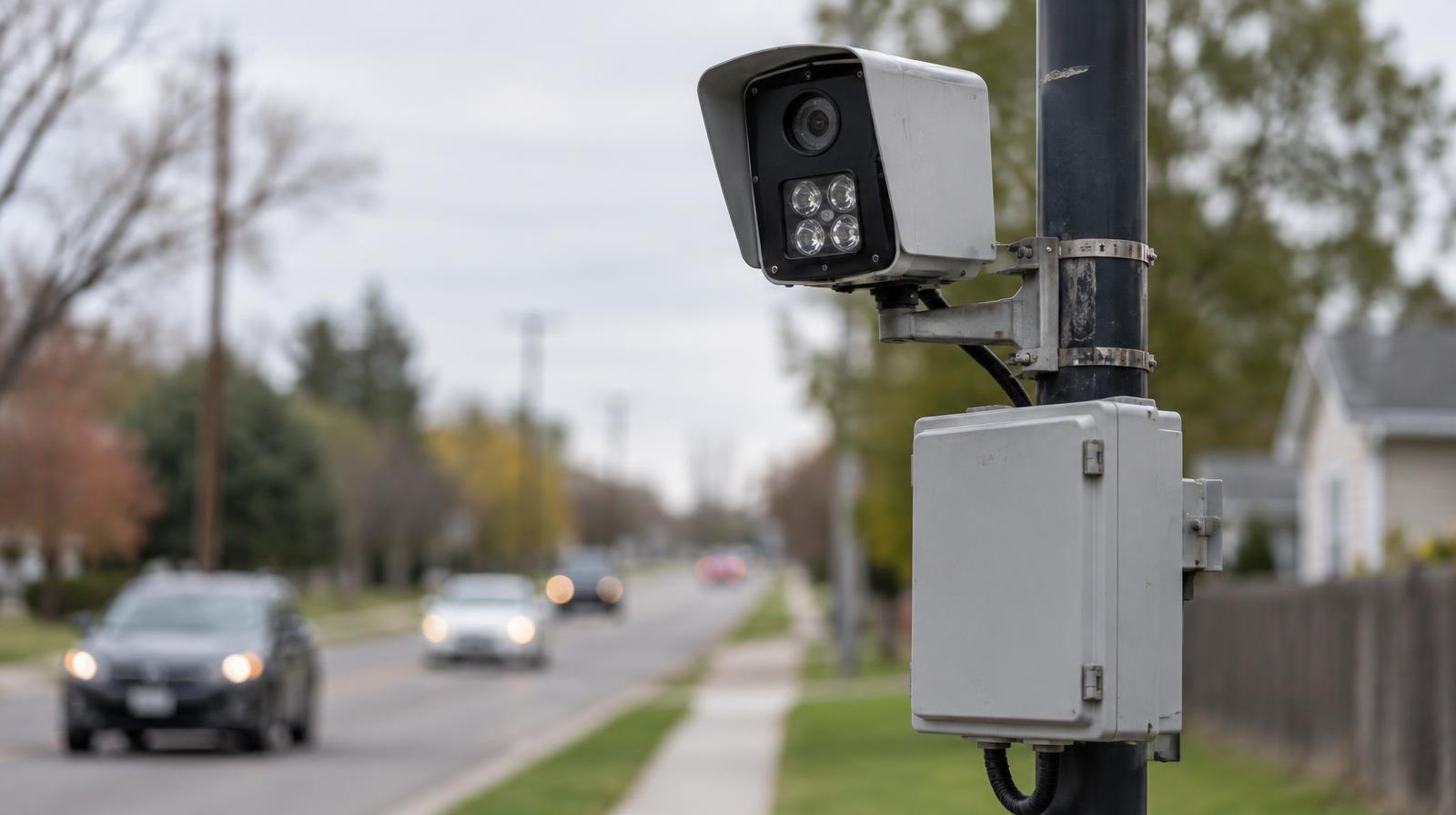
Salem Police have used license plate-reader cameras for nearly two decades. A proposed statewide ban now backed by U.S. Sen. Ron Wyden could put that technology in jeopardy, though the bill has not been drafted and it remains unclear whether Salem's specific systems would be covered.
Wyden joined state lawmakers and the American Civil Liberties Union of Oregon (ACLU of Oregon) at a Monday, Oct. 5, press conference near Clackamas Town Center to endorse a bipartisan bill that would prohibit Flock Safety cameras and similar devices across Oregon. About 400 Flock cameras operate in Oregon, The Oregonian/OregonLive reported, citing company data.
"Let's call this Flock camera … what it is: it is a weapon of mass inspection," Wyden said.
The cameras scan and store license plate data, which law enforcement agencies use to track stolen vehicles and locate suspects. But Wyden said the technology has been abused to enforce abortion bans, track immigrants and stalk women.
Salem's plate-reader history
Salem Police Sgt. Jonathan Hardy told The Oregonian/OregonLive in November 2025 that the department uses Rekor and Vigilant Vehicle Manager systems, not Flock specifically, with data stored on a city server. Hardy said the department has used the technology for nearly 20 years in patrol vehicles and, more recently, at stationary locations.
Salem also received part of nearly $600,000 in state Criminal Justice Commission grants in 2024 to fund automatic license plate readers for investigating theft rings, according to the same report. No Salem official has publicly responded to the proposed ban.
Bipartisan sponsors, uncertain path
State Rep. Willy Chotzen, a Portland Democrat, is the bill's primary sponsor. State Rep. Alek Skarlatos, a Douglas County Republican, is co-sponsoring it. Chotzen said at the press conference that the bill's first draft must be filed by December, and the 2027 legislative session begins in mid-January.
Chotzen said he is "quite confident" the bill will pass. He argued that Oregon's 2026 reforms under Senate Bill 1516 (SB 1516), which limits police data retention to 30 days and lets Oregonians sue plate-reader vendors, did not go far enough.
But the bill faces at least one key hurdle. State Sen. Floyd Prozanski, a Eugene Democrat who chairs the Senate Judiciary Committee, has not committed to supporting it. Prozanski said in January that he values the tool for "legitimate, lawful law enforcement purposes" but believes "there needs to be safeguards and guardrails," according to the Oregon Capital Chronicle.
Flock Safety pushed back. Spokesperson Andrew Smith said in a statement that Oregon's 2026 legislation already put strong privacy and accountability safeguards in place and that a blanket ban would remove a proven investigative tool from Oregon communities.
Privacy concerns and false arrests
Jessica Maravilla, policy director of the ACLU of Oregon, said at the press conference that plate-reader data can be collected on anyone without evidence of wrongdoing. She warned that once location data exists, controlling who accesses it becomes difficult.
A September U.S. Senate hearing underscored those risks. Lindsey Isaacs, a Florida woman, testified that she spent 13 days in jail after a Flock camera misidentified her vehicle in a fatal hit-and-run case, the Oregon Capital Chronicle reported.
Florida Gov. Ron DeSantis ordered Flock cameras removed from the state's highway system in August. Texas Gov. Greg Abbott paused state funding for the cameras.
Chotzen said sponsors still need to decide whether the ban would cover cameras on private property as well as public. The bill's first draft is due by December.